
- Most Important Result: The Higgs exclusion limits from the Tevatron, of course. Anytime now we may get the answer to one of the most important question in particles physics. Not this time yet, but the thrill is on.
- Most Intriguing Result: the forward-backward asymmetry of top decays at CDF has been updated to $15 \pm 5$ percent and lingers 2 sigma away from the SM prediction of approximately 5 percent.
- Most Relieving Result: the poster from the HARP collaboration saying that the LSND anomaly was due to underestimated contamination of the beam with anti-electron neutrinos. If confirmed, that would solve the 10-years-long puzzle what went wrong in LSND.
- Best Presentation: Nicolas Sarkozy. Gee, this guy knows how to talk, especially when contrasted with mumblings physicists. What fervor, what mimics, what gestures (ok, forget the jokes).
- Best Presentation, seriously: Ben Kilminster, Higgs limits from the Tevatron. Maybe it's because when holding the remote he looks just like Colin Farrel in Bruges, or maybe because the presentation was clear, concise, and illuminating.
- Worst Presentation: summary of BSM searches. Unfortunately, good experimental talks are rare. The cardinal sins are too much material, overcrowded slides, superficialness, no attempt at explaining presented results or methodology, and misleading theoretical interpretation.
- Best Animation: the Planck satellite sweeping the sky while uncovering the temperature map. That was just lovely.
- Best Music: given the number of cell phones in the audience, the competition is always fierce in this category. But if what I heard on the first day was really Genesis' Firth of Fifth, that obviously trumps anything.
- Overall Impression: Even though and Paris is always worth a mass, the conference was pretty well organized, and I had fun at times, my opinion about the ICHEP series has not changed. Conferences with 1000+ participants are dinosaurs; more a brontosaurus rather than a T.Rex. Parallel sessions contain some interesting material, but the shortness of the talks and no time for discussions preclude any deeper insight. Plenary sessions on the other hand are typically hasty and overloaded summaries of what we already heard in the parallels. Alas, one needs an astereoid strike for dinosaurs to be replaced by more flexible mammals....so maybe see you again in 2 years, upside down ;-)
Showing posts with label Posts by Jester. Show all posts
Showing posts with label Posts by Jester. Show all posts
Sunday, August 8, 2010
Very Last Summary
This is my last entry on this forum: my summary of the conference...better late than sorry :-)

Saturday, July 31, 2010
Meanwhile in the South: CoGeNT dark matter excluded
Parisians say that il n'y a que Paris. This is roughly true, however ICHEP'10 in Paris was not the only important conference in France last week. At the same time down south in Montpellier there was the IDM conference where a number of results in dark matter searches was presented. One especially interesting result concerns hunting for light dark matter particles.
Some time ago the CoGeNT experiment noted that the events observed in their detector are consistent with scattering of dark matter particles of mass 5-10 GeV. Although CoGeNT could not exclude that they are background, the dark matter interpretation was tantalizing because the same dark matter particle could also fit (with a bit of stretching) the DAMA modulation signal and the oxygen band excess from CRESST.
The possibility that dark matter particles could be so light caught experimenters with their trousers down. Most current experiments are designed to achieve the best sensitivity in the 100 GeV - 1 TeV ballpark, because of prejudices (weak scale supersymmetry) and some theoretical arguments (the WIMP miracle). In the low mass region the sensitivity of current techniques rapidly decreases, event though certain theoretical frameworks (e.g asymmetric dark matter) predict dark matter sitting at a few GeV. For example, experiments with xenon targets detect scintillation (S1) and ionization (S2) signals generated by particles scattering in a detector. Measuring both S1 and S2 ensure very good background rejection, however the scintillation signal is the main showstopper to lowering the detection threshold. Light dark matter particles can give only a tiny push to much heavier xenon atoms, and the experiment is able to collect only a few resulting scintillation photons, if any. Besides, the precise number of photons produced at low recoils (described by the notorious Leff parameter) is poorly known, and the subject is currently fiercely debated with knives, guns, and replies-to-comments-on-rebuttals.
It turns out that this debate may soon be obsolete. Peter Sorensen in his talk at IDM argues that xenon experiments can be far more sensitive to light dark matter than previously thought. The idea is to drop the S1 discrimination, and use only the ionization signal. This allows one to lower the detection threshold down to ~1 keVr (it's a few times higher with S1) and gain sensitivity to light dark matter. Of course, dropping S1 also increases background. Nevertheless, thanks to self-shielding, the number of events in the center of the detector (blue triangles on the plot above) is small enough to allow for setting strong limits. Indeed, using just 12.5 day of aged Xenon10 data a preliminary analysis shows that one can improve on existing limits for the scattering cross section of a light dark matter particle:
 Most interestingly, the region explaining the CoGENT signal (within red boundaries) seems by far excluded. Hopefully, the bigger and more powerful Xenon100 experiment will soon be able to set even more stringent limits. Unless, of course, they will find something...
Some time ago the CoGeNT experiment noted that the events observed in their detector are consistent with scattering of dark matter particles of mass 5-10 GeV. Although CoGeNT could not exclude that they are background, the dark matter interpretation was tantalizing because the same dark matter particle could also fit (with a bit of stretching) the DAMA modulation signal and the oxygen band excess from CRESST.
The possibility that dark matter particles could be so light caught experimenters with their trousers down. Most current experiments are designed to achieve the best sensitivity in the 100 GeV - 1 TeV ballpark, because of prejudices (weak scale supersymmetry) and some theoretical arguments (the WIMP miracle). In the low mass region the sensitivity of current techniques rapidly decreases, event though certain theoretical frameworks (e.g asymmetric dark matter) predict dark matter sitting at a few GeV. For example, experiments with xenon targets detect scintillation (S1) and ionization (S2) signals generated by particles scattering in a detector. Measuring both S1 and S2 ensure very good background rejection, however the scintillation signal is the main showstopper to lowering the detection threshold. Light dark matter particles can give only a tiny push to much heavier xenon atoms, and the experiment is able to collect only a few resulting scintillation photons, if any. Besides, the precise number of photons produced at low recoils (described by the notorious Leff parameter) is poorly known, and the subject is currently fiercely debated with knives, guns, and replies-to-comments-on-rebuttals.
It turns out that this debate may soon be obsolete. Peter Sorensen in his talk at IDM argues that
 xenon experiments can be far more sensitive to light dark matter than previously thought. The idea is to drop the S1 discrimination, and use only the ionization signal. This allows one to lower the detection threshold down to ~1 keVr (it's a few times higher with S1) and gain sensitivity to light dark matter. Of course, dropping S1 also increases background. Nevertheless, thanks to self-shielding, the number of events in the center of the detector (blue triangles on the plot above) is small enough to allow for setting strong limits. Indeed, using just 12.5 day of aged Xenon10 data a preliminary analysis shows that one can improve on existing limits for the scattering cross section of a light dark matter particle:
 Most interestingly, the region explaining the CoGENT signal (within red boundaries) seems by far excluded. Hopefully, the bigger and more powerful Xenon100 experiment will soon be able to set even more stringent limits. Unless, of course, they will find something...
Wednesday, July 28, 2010
Trouble with Flavor
Flavor physics gives me a headache. Unfortunately, this sub-field of particle physics is where new particles and interactions are very likely to show up, so it's essential to follow all hints from latest observations. Yesterday at ICHEP Gino Isidori gave a nice theoretical summary of where we stand.
Overall, the standard model frustratingly well explains the multitude of observed transitions between quarks and leptons of different generations. If we extend the standard model with generic non-renormalizable 4-fermion operators, their coefficients are extremely constrained by experiment. The scale suppressing certain flavor-violating operators has to be at least 100 TeV in the bs sector, at least 1000 TeV in the bd sector, and the astounding $10^5$ TeV in the ds (kaon) sector. It means that if any new particles exist at the TeV scale they better be very careful not to destroy the approximate flavor symmetries of the standard model, as otherwise they would generate effective 4-fermion operators with large coefficients.
That probably means that at the TeV scale there is no new particles beyond those of the standard model. There is still some hope, however, that the above is not true, and this forlorn hope is fueled by three results that are currently in tension with the standard model predictions. One is the widely discussed the D0 measurement of the same-sign dimuon asymmetry which points to new contributions to $B_s-\bar B_s$ meson mixing at 3.2 sigma level. The 2 other less widely known discrepancies are:
Theorists have put up several models that may fit all up-to-date flavor observables and explain the existing anomalies. For Gino, the favorite model is the 2-Higgs doublet model. In this scenario, the Higgs sector contains additional 4 scalar particles who can mediate flavor violating transitions. The point is that they do it in a very respectful way, including the suppression by small CKM angles and by small quark masses, so they not to produce excessively large effects even when the new Higgs particles are at the TeV scale. The quark mass suppression leads to the desired pattern where the smalest new contributions come in the kaon sector, while the largest occur in the Bs meson sector. This scenario also predicts new contributions to $B_s \to \mu \mu$ decay and to the neutron electric dipole moment at the level of the current sensitivity, so fresh tests of this idea are soon to come.
For more details, see the ICHEP'10 slides. As a bonus, a very accurate rendering of theorists waiting for hints of new physics in flavor physics.
Overall, the standard model frustratingly well explains the multitude of observed transitions between quarks and leptons of different generations. If we extend the standard model with generic non-renormalizable 4-fermion operators, their coefficients are extremely constrained by experiment. The scale suppressing certain flavor-violating operators has to be at least 100 TeV in the bs sector, at least 1000 TeV in the bd sector, and the astounding $10^5$ TeV in the ds (kaon) sector. It means that if any new particles exist at the TeV scale they better be very careful not to destroy the approximate flavor symmetries of the standard model, as otherwise they would generate effective 4-fermion operators with large coefficients.
That probably means that at the TeV scale there is no new particles beyond those of the standard model. There is still some hope, however, that the above is not true, and this forlorn hope is fueled by three results that are currently in tension with the standard model predictions. One is the widely discussed the D0 measurement of the same-sign dimuon asymmetry which points to new contributions to $B_s-\bar B_s$ meson mixing at 3.2 sigma level. The 2 other less widely known discrepancies are:
- Various determinations of the beta angle in the unitarity triangle (determined most
 precisely from $B_d \to J/psi K_S$ decays, and from the $\epsilon_K$ parameter in the kaon mixing) do not agree very well. The current discrepancy is around 2.5 sigma.
 - The branching fraction of the $B \to \tau \nu$ decay measured by BaBar and Belle is currently two times larger than the standard model prediction. Given the errors, the current discrepancy with the standard model is around 3 sigma.

Theorists have put up several models that may fit all up-to-date flavor observables and explain the existing anomalies. For Gino, the favorite model is the 2-Higgs doublet model. In this
 scenario, the Higgs sector contains additional 4 scalar particles who can mediate flavor violating transitions. The point is that they do it in a very respectful way, including the suppression by small CKM angles and by small quark masses, so they not to produce excessively large effects even when the new Higgs particles are at the TeV scale. The quark mass suppression leads to the desired pattern where the smalest new contributions come in the kaon sector, while the largest occur in the Bs meson sector. This scenario also predicts new contributions to $B_s \to \mu \mu$ decay and to the neutron electric dipole moment at the level of the current sensitivity, so fresh tests of this idea are soon to come.
For more details, see the ICHEP'10 slides. As a bonus, a very accurate rendering of theorists waiting for hints of new physics in flavor physics.

Monday, July 26, 2010
Higgs still at large
Finally came the moment we all waited for at this conference:
 Tevatron now excludes the standard model Higgs for masses between 156 and 175 GeV. The exclusion window widened considerably since the last combination. Together with the input from direct Higgs searches at LEP and from electroweak precision observables it means that Higgs is most likely hiding somewhere between 115 and 155 GeV (assuming Higgs exists and has standard model properties). We'll get you bastard, sooner or later.
One interesting detail: Tevatron can now exclude a very light standard model Higgs, below 110 GeV. Just in LEP people missed it ;-) Hopefully, Tevatron will soon start tightening the window from the low mass side.

Another potentially interesting detail: there is some excess of events in the $b \bar b$ channel where a light Higgs could possibly show up. The distribution of the s/b likelihood variable (which is some inexplicably complicated function that mortals cannot interpret) has 5 events in one of the higher s/b bins, whereas only 0.8 expected. This cannot be readily interpreted as the standard model Higgs signal, as then one would also expect events at higher s/b where there is none. Most likely the excess is a fluke, or maybe some problem with background modeling. But it could also be an indication that something weird is going on that does not fit the standard model Higgs paradigm. Maybe upcoming Tevatron publications will provide more information.
 Tevatron now excludes the standard model Higgs for masses between 156 and 175 GeV. The exclusion window widened considerably since the last combination. Together with the input from direct Higgs searches at LEP and from electroweak precision observables it means that Higgs is most likely hiding somewhere between 115 and 155 GeV (assuming Higgs exists and has standard model properties). We'll get you bastard, sooner or later.
One interesting detail: Tevatron can now exclude a very light standard model Higgs, below 110 GeV. Just in LEP people missed it ;-) Hopefully, Tevatron will soon start tightening the window from the low mass side.

Another potentially interesting detail: there is some excess of events in the $b \bar b$ channel where a light Higgs could possibly show up. The distribution of the s/b likelihood variable (which is some inexplicably complicated function that mortals cannot interpret) has 5 events in one of the higher s/b bins, whereas only 0.8 expected. This cannot be readily interpreted as the standard model Higgs signal, as then one would also expect events at higher s/b where there is none. Most likely the excess is a fluke, or maybe some problem with background modeling. But it could also be an indication that something weird is going on that does not fit the standard model Higgs paradigm. Maybe upcoming Tevatron publications will provide more information.
Saturday, July 24, 2010
D0 says: neither dead nor alive
This year CP violation in the Bs meson system has made the news, including BBC News and American Gardener. The D0 measurement of the same-sign dimuon asymmetry in B decays got by far the largest publicity. Recall that Tevatron's D0 reported 1 percent asymmetry at the 3.1 sigma confidence level, whereas the standard model predicts a much smaller value. That would suggest a new source of CP violation, perhaps new heavy particles that we could later discover at the LHC.
The dimuon asymmetry is not the only observable sensitive to CP violation in the Bs system. Another accessible observable is the CP violating phase in time-dependent Bs decays into the J/ψ φ final state. In principle, the dimuons and J/ψ φ are 2 different measurements that do not have to be correlated. But there are (not completely bullet-proof) theoretical arguments that a large deviation from the standard model in one should results in an observable deviation in the other. This is the case, in particular, if new physics enters via a phase in $M_{12}$ (the so-called dispersive part of the mixing amplitude, as opposed to the absorptive part $\Gamma_{12}$), which is expected if the new particles contributing to that amplitude are heavy. The previous, 2-years old combination of the CDF and D0 measurements displayed an intriguing 2.1 sigma discrepancy with the standard model. CDF updated their result 2 months ago and, disappointingly, their results seems perfectly consistent with the standard model. D0 revealed their update today in an overcrowded room at ICHEP. Here is their new fit to the CP violating phase vs. the difference of the widths of the 2 Bs mass eigenstates
 Basically, D0 sees the same 1.5 sigmish discrepancy with the standard model as before. Despite 2 times larger statistics, the discrepancy is neither going away nor decreasing, leaving us in the dark. Time will tell whether D0 found hints of new sources of CP violation in nature,
or merely hints of complicated systematical effects in their detector.
The dimuon asymmetry is not the only observable sensitive to CP violation in the Bs system.
 Another accessible observable is the CP violating phase in time-dependent Bs decays into the J/ψ φ final state. In principle, the dimuons and J/ψ φ are 2 different measurements that do not have to be correlated. But there are (not completely bullet-proof) theoretical arguments that a large deviation from the standard model in one should results in an observable deviation in the other. This is the case, in particular, if new physics enters via a phase in $M_{12}$ (the so-called dispersive part of the mixing amplitude, as opposed to the absorptive part $\Gamma_{12}$), which is expected if the new particles contributing to that amplitude are heavy. The previous, 2-years old combination of the CDF and D0 measurements displayed an intriguing 2.1 sigma discrepancy with the standard model. CDF updated their result 2 months ago and, disappointingly, their results seems perfectly consistent with the standard model. D0 revealed their update today in an overcrowded room at ICHEP. Here is their new fit to the CP violating phase vs. the difference of the widths of the 2 Bs mass eigenstates
 Basically, D0 sees the same 1.5 sigmish discrepancy with the standard model as before. Despite 2 times larger statistics, the discrepancy is neither going away nor decreasing, leaving us in the dark. Time will tell whether D0 found hints of new sources of CP violation in nature,
or merely hints of complicated systematical effects in their detector.
Heavy Long-lived Particles at the LHC
Yesterday at ICHEP CMS and ATLAS presented their searches of long-lived charged particles. Most of the particles we deal with at the LHC decay almost immediately, basically right at the collision point, and one needs to reconstruct them from their decay product such as electrons, photons, muons or jets. However, it's conceivable that there exist new particles whose lifetime is 100 nanoseconds or more, in which case they traverse the entire detector before decaying (recall that the speed of light is one foot per nanosecond ;-). If these particles have an electric or color charge, they will leave a mark of their passage. Long-lived charged particles arise in many extensions of the standard model. The best known example is gauge mediated supersymmetry with a high scale of supersymmery breaking. In this case the lightest (and stable) supersymmetric particle is typically the gravitino who itself is uncharged. But the next-to-lightest supersymmetric particle may be charged (it could be stau, for example) and couples very weakly to the gravitino, in which case it lives very long for particle physics (or even human) standards. Supersymmetry is just one example; there are tons of less or more motivated models that predict long-lived particles.
So what does such a long lived particle looks like? It slashes through the detector all the way to the muon chambers, leaving an energetic track in the tracker but little energy deposition in the calorimeters. In other words, it looks much like a muon, and in most case it will be identified as one by online systems. But it can be distinguished from a muon by looking more closely at its traces. First of all, we expect it to be heavy (100 GeV or more, otherwise LEP would have seen it before), and therefore the track will have a large transverse momentum. Another consequence of the large mass is that the majority of these particels are produced with small velocities (where small here means a fraction of the speed of light, say 0.3 -0.7c). The Bethe-Bloch equation tells us that slow moving particles will lose energy faster when passing through matter. Thus, one can find heavy long-lived charged particles by looking for an excess of tracks with high pT and high dE/dx (one can also look at the time-of-flight, or the number of hits in the tracker). CMS, who seems more advanced in this search than ATLAS, already presented the first limits based on 200 nb-1 of data. The limits are not competitive with those of the Tevatron yet, but this will change soon.
 Actually, long-lived charged particle may lose so much energy when passing through the detector that they stop altogether, and then decay after a while.This can readily happen for strongly interacting particles, such as long-lived gluinos that arise for example in split supersymmetry. Since in this case the particle does not reach the muon system, the search is more challenging and also more spectacular. Namely, one searches for localized energy bursts in the calorimeter during the time when there is no collisions, e.g. between beam crossings or when the accelerator is switched off altogether. CMS has already first limits on these events, and in this case they are already better than the Tevatron limits in a part of the parameter space.
 It's reassuring that from day one the LHC plunges into out-of-the-box searches that some call exotic. My hunch is that, if there's any new physics at the TeV scale at all, it will take some unexpected form that will require non-standard techniques to discover. And the added value is that in these less explored corners of particle phenomenology interesting results and non-trivial limits can be obtained relatively fast, even during the first year of the LHC running.
So what does such a long lived particle looks like? It slashes through the detector all the way to
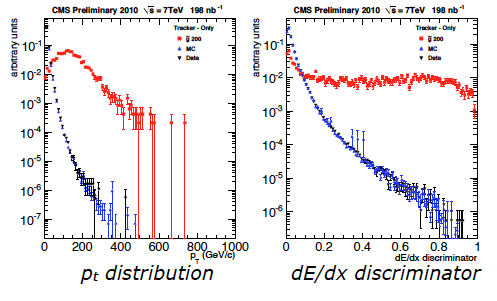 the muon chambers, leaving an energetic track in the tracker but little energy deposition in the calorimeters. In other words, it looks much like a muon, and in most case it will be identified as one by online systems. But it can be distinguished from a muon by looking more closely at its traces. First of all, we expect it to be heavy (100 GeV or more, otherwise LEP would have seen it before), and therefore the track will have a large transverse momentum. Another consequence of the large mass is that the majority of these particels are produced with small velocities (where small here means a fraction of the speed of light, say 0.3 -0.7c). The Bethe-Bloch equation tells us that slow moving particles will lose energy faster when passing through matter. Thus, one can find heavy long-lived charged particles by looking for an excess of tracks with high pT and high dE/dx (one can also look at the time-of-flight, or the number of hits in the tracker). CMS, who seems more advanced in this search than ATLAS, already presented the first limits based on 200 nb-1 of data. The limits are not competitive with those of the Tevatron yet, but this will change soon.
 Actually, long-lived charged particle may lose so much energy when passing through the detector that they stop altogether, and then decay after a while.This can readily happen for strongly interacting particles, such as long-lived gluinos that arise for example in split supersymmetry. Since in this case the particle does not reach the muon system, the search is more challenging and also more spectacular. Namely, one searches for localized energy bursts in the calorimeter during the time when there is no collisions, e.g. between beam crossings or when the accelerator is switched off altogether. CMS has already first limits on these events, and in this case they are already better than the Tevatron limits in a part of the parameter space.
 It's reassuring that from day one the LHC plunges into out-of-the-box searches that some call exotic. My hunch is that, if there's any new physics at the TeV scale at all, it will take some unexpected form that will require non-standard techniques to discover. And the added value is that in these less explored corners of particle phenomenology interesting results and non-trivial limits can be obtained relatively fast, even during the first year of the LHC running.
Friday, July 23, 2010
Limits on interaction strength
Advancements in our understanding of quantum field theory (QFT) are rare these days. Papa Weinberg and others worked out all the easy stuff back in the 70s, and since that time we had only isolated flashes of genius such as Seiberg-Witten or AdS/CFT. Yesterday at ICHEP I heard the talk of Slava Rychkov about one of the two most interesting advancements that happened last year.
In the real world there seems to be some constraint on the interaction strength. In QFT, the interaction strength is represented by a coupling constant which is related to the probability of a particle splitting into 2 or more particles. In the first approximation, the larger the coupling constant, the larger the interaction strength. However in all examples we are aware of the interaction strength cannot be arbitrarily increased. When the coupling constant reaches the value of order 4 $\pi$, rather than interactions becoming stronger and stronger, the theory undergoes a phase transition. A new theoretical theoretical description with new effective particles emerges, and these new particles interact with a finite strength. The well know example is QCD: at low energies when the strong coupling constant grows very large the theory of quarks and gluons rearranges into the theory of mesons and baryons who interact with the final strength.
So, is there some hard-wired limit on the interaction strength in QFT? For the moment, such limits can be derived only in the context of conformal QFTs (abbreviated as CFTs). CFTs do not describe the real worlds particle physics, as conformal invariance is not compatible with massive particles. But CFT may be an effective description of some subsystems of the real world. Condensed matter physicists in their laboratories routinely produce materials that can be well described by CFT. In our field, there are ideas that the Higgs boson could emerge from another sector that is approximately conformal sector over a large range of energy scales. More recently, particle phenomenologists entertained the idea of unparticles, that is a conformal sector that weakly couples to standard model particles so that this weird stuff can be produced in colliders.
It turns that in CFT there are concrete limits on the interaction strength, more precisely on the 3-point function of primary operators. These limits can be derived using operator product expansion (in this context, conformal block decomposition) and requiring that it satisfies crossing symmetry. The rest is some algebra and a clever rearrangement of terms in the expansion. The result as a function of the operator dimension is shown on the plot below.
 So, indeed, the interaction strength cannot be arbitrarily large. This result limits the options of what can be observed at the LHC in certain unparticle scenarios. Similar methods can be used to derive bounds on possible operator dimensions in CFT.
See the slides or the original paper.
In the real world there seems to be some constraint on the interaction strength. In QFT, the interaction strength is represented by a coupling constant which is related to the probability of a particle splitting into 2 or more particles. In the first approximation, the larger the coupling constant, the larger the interaction strength. However in all examples we are aware of the interaction strength cannot be arbitrarily increased. When the coupling constant reaches the value of order 4 $\pi$, rather than interactions becoming stronger and stronger, the theory undergoes a phase transition. A new theoretical theoretical description with new effective particles emerges, and these new particles interact with a finite strength. The well know example is QCD: at low energies when the strong coupling constant grows very large the theory of quarks and gluons rearranges into the theory of mesons and baryons who interact with the final strength.
So, is there some hard-wired limit on the interaction strength in QFT? For the moment, such limits can be derived only in the context of conformal QFTs (abbreviated as CFTs). CFTs do not describe the real worlds particle physics, as conformal invariance is not compatible with massive particles. But CFT may be an effective description of some subsystems of the real world. Condensed matter physicists in their laboratories routinely produce materials that can be well described by CFT. In our field, there are ideas that the Higgs boson could emerge from another sector that is approximately conformal sector over a large range of energy scales. More recently, particle phenomenologists entertained the idea of unparticles, that is a conformal sector that weakly couples to standard model particles so that this weird stuff can be produced in colliders.
It turns that in CFT there are concrete limits on the interaction strength, more precisely on the 3-point function of primary operators. These limits can be derived using operator product expansion (in this context, conformal block decomposition) and requiring that it satisfies crossing symmetry. The rest is some algebra and a clever rearrangement of terms in the expansion. The result as a function of the operator dimension is shown on the plot below.
 So, indeed, the interaction strength cannot be arbitrarily large. This result limits the options of what can be observed at the LHC in certain unparticle scenarios. Similar methods can be used to derive bounds on possible operator dimensions in CFT.
See the slides or the original paper.
Monday, July 19, 2010
Expectations for ICHEP
3 days before the kick off of ICHEP'10 is the high time to share my hopes, fears, and expectations. Definitely, the conference is going to be a unique experience for me because it's my first time as press :-) But from the scientific point of view my emotions are mixed. Like most fellow theorists I'm rather skeptical about supersize conferences such as ICHEP. This sort of meetings used to play an important role as the venue to learn of new ideas and results in the field. Today, however, when information travels faster than light, when almost every relevant result is instantly available via arXiv, and when one can skype anyone on the globe with just one click, big conferences seem to be a relic of the 20th century. Personally I don't expect to learn of any new theoretical results in this conference, even if listening to first-hand presentations is always illuminating and may add to my understanding.
Fortunately for ICHEP things can be interesting thanks to experimentalists who generally have a completely different view of the conference. The working cycle in experimental physics often involves finalizing results for big conferences such as ICHEP, Lepton-Photon or Moriond, so as to get more exposure. This is perfectly understandable. After spending the entire year in soggy basements where the only light is the laptop screen experimentalists should excercise some decorum when the results of their work are presented to the world. This approach guarantees a decent number of brand new experimental results for this year's ICHEP.
What am I waiting for the most? This summer is very special because the first serious LHC results will be presented. Of course, none of these results could even vaguely be interesting for a wider public. With merely a couple hundreds inverse nanobarn acquired so far, and only a fraction of that analyzed, the LHC can only access bread-and-butter physics such as W,Z, or b-quark production. Still it is interesting to watch the baby growing, even if all it can say is ba-ba-ba. The new results will give us a feel of the LHC performance, and should soon provide some indirect benefits in the form of better simulation tools for more interesting processes.
And then there is the old Tevatron who does not want to pass away just yet. The most expected results that will be presented at ICHEP are related to Higgs physics. The National Enquirer's reports that Higgs has been discovered turned out to be slightly exaggerated, so instead we are going to see new limits on the Higgs mass and cross section. The other hot issue at the Tevatron right now is flavor physics and CP violation, following D0's claim that they found evidence for new physics in Bs meson decays. ICHEP will add at least one important result: the update of the D0 measurement of the CP violation in Bs to J/Psi Phi decays. The earlier D0 measurement was 2-sigmish away from the standard model, while the latest CDF update is completely consistent with the standard model. We will see soon whether we'll have more or less reason to believe in new physics in the Bs meson system. On top of that, the Tevatron will show interesting result from top physics and from a number of standard and non-standard new physics searches. Not that there is any hope of positive signals in the latter...
What else? There seem to be interesting sessions devoted to dark matter searches, although in these cases the crucial results will probably first be shown on more specialized conferences such as TeVPA or IDM. Neutrino physics has recently become a bit more interesting due to weird hints from miniBoone and Minos, and we'll get a lot of neutrino exposure during ICHEP. Maybe something else that I haven't thought of could surprise me? As long as there's coffee, there's hope.
Fortunately for ICHEP things can be interesting thanks to experimentalists who generally have a completely different view of the conference. The working cycle in experimental physics often involves finalizing results for big conferences such as ICHEP, Lepton-Photon or Moriond, so as to get more exposure. This is perfectly understandable. After spending the entire year in soggy basements where the only light is the laptop screen experimentalists should excercise some decorum when the results of their work are presented to the world. This approach guarantees a decent number of brand new experimental results for this year's ICHEP.
What am I waiting for the most? This summer is very special because the first serious LHC results will be presented. Of course, none of these results could even vaguely be interesting for a wider public. With merely a couple hundreds inverse nanobarn acquired so far, and only a fraction of that analyzed, the LHC can only access bread-and-butter physics such as W,Z, or b-quark production. Still it is interesting to watch the baby growing, even if all it can say is ba-ba-ba. The new results will give us a feel of the LHC performance, and should soon provide some indirect benefits in the form of better simulation tools for more interesting processes.
And then there is the old Tevatron who does not want to pass away just yet. The most expected results that will be presented at ICHEP are related to Higgs physics. The National Enquirer's reports that Higgs has been discovered turned out to be slightly exaggerated, so instead we are going to see new limits on the Higgs mass and cross section. The other hot issue at the Tevatron right now is flavor physics and CP violation, following D0's claim that they found evidence for new physics in Bs meson decays. ICHEP will add at least one important result: the update of the D0 measurement of the CP violation in Bs to J/Psi Phi decays. The earlier D0 measurement was 2-sigmish away from the standard model, while the latest CDF update is completely consistent with the standard model. We will see soon whether we'll have more or less reason to believe in new physics in the Bs meson system. On top of that, the Tevatron will show interesting result from top physics and from a number of standard and non-standard new physics searches. Not that there is any hope of positive signals in the latter...
What else? There seem to be interesting sessions devoted to dark matter searches, although in these cases the crucial results will probably first be shown on more specialized conferences such as TeVPA or IDM. Neutrino physics has recently become a bit more interesting due to weird hints from miniBoone and Minos, and we'll get a lot of neutrino exposure during ICHEP. Maybe something else that I haven't thought of could surprise me? As long as there's coffee, there's hope.
Friday, July 16, 2010
Muonic Hydrogen and Dark Forces
The measurement of the Lamb shift in the muonic hydrogen has echoed on blogs and elsewhere. Briefly, an experiment at the Paul Scherrer Institute (PSI) measured the energy difference between 2S(1/2) and 2P(3/2) energy levels of an atom consisting of a muon orbiting a proton. Originally, this excercise was intended as a precise determination of the charge radius (that is the size) of the proton: in the muonic hydrogen the finite proton size effect can shift certain energy levels by order one percent, much more than in the ordinary hydrogen, while other contributions to the energy levels are quite precisely known from theory. Indeed, the PSI measurement of the proton charge radius is 10 times more precise than previous measurements based on the Lamb shift in the ordinary hydrogen and on low-energy electron-proton scattering data. Intriguingly, the new result is inconsistent with the previous average at the 5 sigma level.
As usual, when an experimental result is inconsistent with the standard model prediction the most likely explanation is an experimental error or a wrong theoretical calculation. In this particular case the previous experimental data on the proton charge radius do not seem to be rock-solid, at least to a casual observer. For example, if the charge radius is extracted from electron–proton scattering the discrepancy with the PSI measurement becomes only 3.1 sigma; the PSI paper also quotes another recent measurement that is completely consistent with their result within error bars.
In any case, whenever a discrepancy with the standard model pops up, particle theorists cannot help thinking about new physics explanations. Our folk is notorious for ambulance chasing, but actually this is one of these cases when the ambulance is coming straight at us. Recently the particle community has invested a lot of interest in studies of light, hidden particles very weakly coupled to the ordinary matter. One example is the so-called dark photon: an MeV-GeV mass particle with milli-charge couplings to electrons and muons. This idea is pretty old, but in the past 2 years the interest in dark photons was boosted because their existence could explain certain astrophysical anomalies (Pamela). The signals of dark photons and other hidden particles are now being searched for at the Tevatron, LHC, B-factories, and in dedicated experiments such as ALPS at DESY, or APEX that is just kicking off at JLAB. No signal has been found in these experiments yet, but there is still a lot of room for the dark photon as long as its coupling to electrons and muons is $\epsilon \leq 10^{-3}$ smaller than that of the ordinary photon, see the picture borrowed from this paper. The news of the muonic Lamb shift came somewhat unexpectedly...but not to everyone: here is a passage from a 2-years old paper:
As usual, when an experimental result is inconsistent with the standard model prediction the most likely explanation is an experimental error or a wrong theoretical calculation. In this particular case the previous experimental data on the proton charge radius do not seem to be rock-solid, at least to a casual observer. For example, if the charge radius is extracted from electron–proton scattering the discrepancy with the PSI measurement becomes only 3.1 sigma; the PSI paper also quotes another recent measurement that is completely consistent with their result within error bars.
In any case, whenever a discrepancy with the standard model pops up, particle theorists cannot help thinking about new physics explanations. Our folk is notorious for ambulance chasing, but actually this is one of these cases when the ambulance is coming straight at us. Recently the particle community has invested a lot of interest in studies of light, hidden particles very weakly coupled to the ordinary matter. One example is the so-called dark photon: an MeV-GeV
 mass particle with milli-charge couplings to electrons and muons. This idea is pretty old, but in the past 2 years the interest in dark photons was boosted because their existence could explain certain astrophysical anomalies (Pamela). The signals of dark photons and other hidden particles are now being searched for at the Tevatron, LHC, B-factories, and in dedicated experiments such as ALPS at DESY, or APEX that is just kicking off at JLAB. No signal has been found in these experiments yet, but there is still a lot of room for the dark photon as long as its coupling to electrons and muons is $\epsilon \leq 10^{-3}$ smaller than that of the ordinary photon, see the picture borrowed from this paper. The news of the muonic Lamb shift came somewhat unexpectedly...but not to everyone: here is a passage from a 2-years old paper:
For example, the dark photon contribution to the electron-proton scattering amplitude at low momenta is equivalent to the $6 \epsilon^2 /m_A^2$ correction to the proton charge radius (...) It remains to be seen whether other precision QED tests (e.g. involving muonic atoms) would be able to improve on the current constraints.So here we are. In the coming weeks we should see whether there exist concrete models capable of fitting all data. In any case, a new front in the battle against dark forces has just been opened. Now, could someone make us a muonium?
Saturday, May 29, 2010
Important update from CDF
Last week the D0 experiment at the Tevatron presented the new measurement of the same-sign dimuon charge asymmetry in B-meson decays. This asymmetry probes CP violation in B-mesons, including the $B_s$ mesons that have been less precisely studied than their $B_d$ friends and may still hold surprises in store. D0 claimed that their measurement is inconsistent with the standard model at the 3.2 sigma level and hints to a new physics contribution to the $B_s \bar B_s$ mixing. 3 sigma anomalies in flavor physics are not unheard of, but in this case there were reasons to get excited. One was that the $B_s$ system is a natural place for new physics to show up, because the standard model contribution to the CP-violating mixing phase is tiny, and theoretical predictions are fairly clean. The other reason was that the D0 anomaly seemed to go along well with earlier measurements of CP violation in the $B_s$ system. Namely, the measurement of CP violation in the time-dependent tagged $B_s \to J/\psi \phi$ decays displayed a 2.1 sigma discrepancy with the standard model, and some claimed the discrepancy is even higher when combined with all other flavor data. In other words, all measurements (except for $B_s \to D_s \mu X$ that however has a larger error) of the phase in the $B_s \bar B_s$ mixing consistently pointed toward new physics.
Disappointingly for most theorists, another Tevatron's experiment CDF recently presented an update that reverses that trend. CDF repeated the measurement of $B_s \to J/\psi \phi$ on a larger data sample of 5.2 inverse femtobarn, that is with 2 times larger statistics than in the previous measurement. The new result is consistent with the standard model at the 0.8 sigma level:
 So at this moment only one experiment claims to see an anomaly in the $B_s$ system, while another measurement of the $B_s \bar B_s$ mixing phase is perfectly consistent with the standard model. Of course, further measurements of the mixing phase may bring another twist to the story...hopefully, new illuminating experimental results will be presented at ICHEP 2010.
Disappointingly for most theorists, another Tevatron's experiment CDF recently presented an update that reverses that trend. CDF repeated the measurement of $B_s \to J/\psi \phi$ on a larger data sample of 5.2 inverse femtobarn, that is with 2 times larger statistics than in the previous measurement. The new result is consistent with the standard model at the 0.8 sigma level:
 So at this moment only one experiment claims to see an anomaly in the $B_s$ system, while another measurement of the $B_s \bar B_s$ mixing phase is perfectly consistent with the standard model. Of course, further measurements of the mixing phase may bring another twist to the story...hopefully, new illuminating experimental results will be presented at ICHEP 2010.
Monday, May 17, 2010
New Physics Claim from D0!
Tevatron not dead, or so it seems. Although these days all eyes are turned to the LHC, the old Tevatron is still capable to send the HEP community into an excited state. Last Friday the D0 collaboration presented results of a measurement suggesting the standard model is not a complete description of physics in colliders. The paper is already available at this link, and it should be out on arXiv tonight.
The measurement in question concerns CP violation in B-meson systems, that is quark-antiquark bound states containing one b quark. Neutral B-mesons can oscillate into its own antiparticles and the oscillation probability can violate CP (much as it happens with kaons, although the numbers and the observables are different). There are two classes of neutral B-mesons: Bd and its antiparticle Bd where one bottom quark (antiquark) marries one down antiquark (quark), and Bs, Bs with the down quark replaced by the strange quark. Both these classes are routinely produced Tevatron's proton-antiproton collisions roughly in fifty-fifty proprtions, unlike in B-factories where mostly Bd Bd have been produced. Thus, the Tevatron provides us with complementary information about CP violation in nature.
There are many final states where one can study B-mesons (far too many, that's why B-physics gives stomach contractions). The D0 collaboration focused on the final states with 2 muons of the same sign. This final state can arise in the following situation. A collision produces a b \bar b quark pair which hadronizes to B and B mesons. Bottom quarks can decay via charged currents (with virtual W boson), and one possible decay channel is b -> c μ- νμ. Thanks to this channel, the B meson sometimes (with roughly 10 percent probability) decays to a negatively charged muon, B -> μ- X, and analogously, the B meson can decay to a positively charged antimuon. However, due to BB oscillations B-mesons can also decay to a "wrong sign" muon: B -> μ+ X, B -> μ- X. Thus oscillation allow the BB pair to decay into two same sign muons a fraction of the times.
Now, in the presence of CP violation the B->B and B->B oscillation processes occur with different probabilities. Thus, even though at the Tevatron we start with the CP symmetric initial state, at the end of the day there can be slightly more -- than ++ dimuon final states. To study this effect, the D0 collaboration measured the asymmetry
The measurement is not as easy as it seems because there are pesky backgrounds that have to be carefully taken into account. The dominant background comes from ubiquitous kaons or pions that can sometimes be mistaken for muons. These particles may contribute to the asymmetry because the D0 detector itself violates CP: due to budget cuts the Tevatron abandoned construction of the D0 detector made of antimatter. In particular, the kaon K+ happens to travel further than K- in the detector material and may fake the positive value of asymmetry.
At the end of the day, after (hopefully) carefully subtracting the backgrounds, D0 quotes the measured asymmetry to be
Of course, it's too early to celebrate the downfall of the standard model, as in the past the bastard have recovered from similar blows. Yet there are reasons to get excited. The most important one is that the latest D0 result goes well in hand with the anomaly in the Bs system reported by the Tevatron 2 years ago. The asymmetry measured by D0 receives contributions from both Bs and Bd mesons. The Bd mesons are much better studied because they were produced by tons in BaBar and Belle, and to everyone's disappointment they were shown to behave according to the standard model predictions. However BaBar and Belle didn't produce too many Bs mesons (their beams were tuned to the Upsilon(4s) resonance which is a tad too light to decay into Bs mesons), and so the Bs sector can still hold surprises. Two years ago CDF and D0 measured CP violation in Bs decays into J/ψ φ, and they both saw a small, 2-sigma level discrepancy from the standard model. When these 2 results are combined with all other flavor physics data it was argued that the discrepancy becomes more than 3 sigma. The latest D0 results is another strong hint that something fishy is going on in the Bs sector.
Both the old and the new anomaly prompts introducing to the fundamental lagrangian a new effective four-fermion operator, ∼ (b s)2 + h.c., that contributes to the amplitude of Bs Bs oscillations. At this point we have no hints whatsoever what could be the source of this new operator, and the answer may even lie beyond the reach of the LHC. In any case, in the coming weeks theorists will derive this operator using extra dimensions, little Higgs, fat Higgs, unparticles, supersymmetry, old newspapers, golf balls, and tires. Yet the most important question is whether the asymmetry is real, and we're dying to hear from CDF and Belle... Looking forward to Session 06 of ICHEP, maybe we'll know more then :-)
The measurement in question concerns CP violation in B-meson systems, that is quark-antiquark bound states containing one b quark. Neutral B-mesons can oscillate into its own antiparticles and the oscillation probability can violate CP (much as it happens with kaons, although the numbers and the observables are different). There are two classes of neutral B-mesons: Bd and its antiparticle Bd where one bottom quark (antiquark) marries one down antiquark (quark), and Bs, Bs with the down quark replaced by the strange quark. Both these classes are routinely produced Tevatron's proton-antiproton collisions roughly in fifty-fifty proprtions, unlike in B-factories where mostly Bd Bd have been produced. Thus, the Tevatron provides us with complementary information about CP violation in nature.
There are many final states where one can study B-mesons (far too many, that's why B-physics gives stomach contractions). The D0 collaboration focused on the final states with 2 muons of the same sign. This final state can arise in the following situation. A collision produces a b \bar b quark pair which hadronizes to B and B mesons. Bottom quarks can decay via charged currents (with virtual W boson), and one possible decay channel is b -> c μ- νμ. Thanks to this channel, the B meson sometimes (with roughly 10 percent probability) decays to a negatively charged muon, B -> μ- X, and analogously, the B meson can decay to a positively charged antimuon. However, due to BB oscillations B-mesons can also decay to a "wrong sign" muon: B -> μ+ X, B -> μ- X. Thus oscillation allow the BB pair to decay into two same sign muons a fraction of the times.

Now, in the presence of CP violation the B->B and B->B oscillation processes occur with different probabilities. Thus, even though at the Tevatron we start with the CP symmetric initial state, at the end of the day there can be slightly more -- than ++ dimuon final states. To study this effect, the D0 collaboration measured the asymmetry
Aslb = (Nb++ - Nb--)/(Nb++ + Nb--) .
The standard model predicts a very tiny value for this asymmetry, of order 10-4, which is below the sensitivity of the experiment. This is cool, because simply an observation of the asymmetry provides an evidence for contributions of new physics beyond the standard model.The measurement is not as easy as it seems because there are pesky backgrounds that have to be carefully taken into account. The dominant background comes from ubiquitous kaons or pions that can sometimes be mistaken for muons. These particles may contribute to the asymmetry because the D0 detector itself violates CP: due to budget cuts the Tevatron abandoned construction of the D0 detector made of antimatter. In particular, the kaon K+ happens to travel further than K- in the detector material and may fake the positive value of asymmetry.
At the end of the day, after (hopefully) carefully subtracting the backgrounds, D0 quotes the measured asymmetry to be
Aslb = -0.00957 ± 0.00251(stat) ± 0.00146 (syst),
that is the number of produced muons is larger than the number of produced antimuons with the statistical significance estimated to be 3.2 sigma. The asymmetry is some 100 times larger than predicted by the standard model!Of course, it's too early to celebrate the downfall of the standard model, as in the past the bastard have recovered from similar blows. Yet there are reasons to get excited. The most important one is that the latest D0 result goes well in hand with the anomaly in the Bs system reported by the Tevatron 2 years ago. The asymmetry measured by D0 receives contributions from both Bs and Bd mesons. The Bd mesons are much better studied because they were produced by tons in BaBar and Belle, and to everyone's disappointment they were shown to behave according to the standard model predictions. However BaBar and Belle didn't produce too many Bs mesons (their beams were tuned to the Upsilon(4s) resonance which is a tad too light to decay into Bs mesons), and so the Bs sector can still hold surprises. Two years ago CDF and D0 measured CP violation in Bs decays into J/ψ φ, and they both saw a small, 2-sigma level discrepancy from the standard model. When these 2 results are combined with all other flavor physics data it was argued that the discrepancy becomes more than 3 sigma. The latest D0 results is another strong hint that something fishy is going on in the Bs sector.
Both the old and the new anomaly prompts introducing to the fundamental lagrangian a new effective four-fermion operator, ∼ (b s)2 + h.c., that contributes to the amplitude of Bs Bs oscillations. At this point we have no hints whatsoever what could be the source of this new operator, and the answer may even lie beyond the reach of the LHC. In any case, in the coming weeks theorists will derive this operator using extra dimensions, little Higgs, fat Higgs, unparticles, supersymmetry, old newspapers, golf balls, and tires. Yet the most important question is whether the asymmetry is real, and we're dying to hear from CDF and Belle... Looking forward to Session 06 of ICHEP, maybe we'll know more then :-)
Subscribe to:
Posts (Atom)